Ironman training plan
Ironman Training Plan for Full-Distance Preparation
The Ironman plan you won't outgrow by week 6 — rebuilt weekly as your fitness and your life move. 140.6 without wrecking your body or your family calendar.
Best for
Full-distance triathletes who need a season plan that manages fatigue as seriously as fitness.
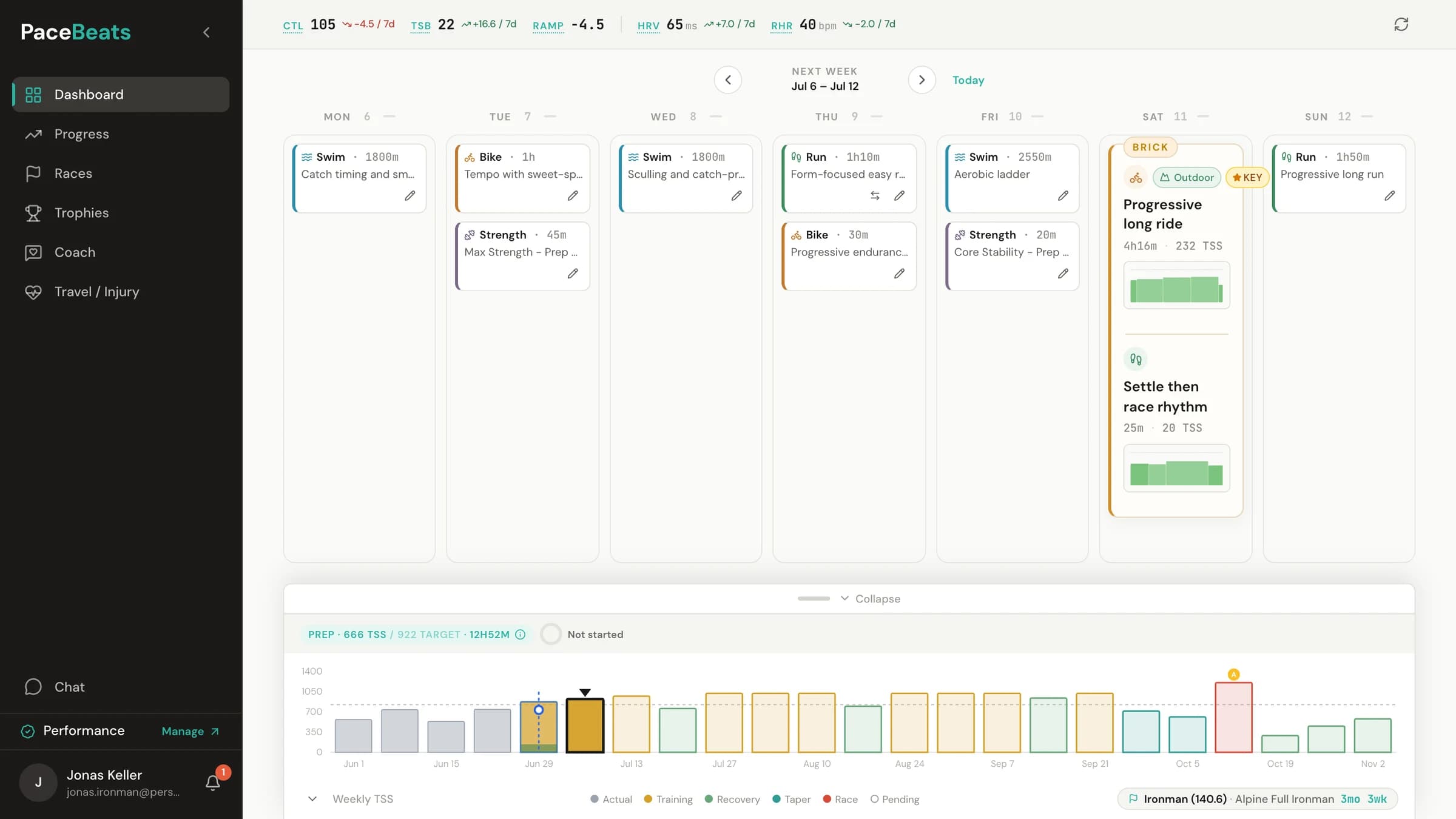
A real week from a PaceBeats athlete building toward this race — built from their Garmin history, rebuilt every week.
Ironman training is a fatigue-management problem
The biggest risk is not a lack of hard workouts. It is accumulating fatigue faster than your body can absorb it.
- Long rides drive much of the aerobic and fueling preparation
- Run durability must grow without excessive impact cost
- Swim consistency reduces race-day energy burn
- Recovery weeks need a purpose, not guilt
Plan the season around durability
PaceBeats uses your current load and race date to build phases that move from general endurance to full-distance specificity.
- Preparation phase builds routine and movement quality
- Base phase raises aerobic volume with controlled intensity
- Build phase adds race-specific bike/run combinations
- Peak phase rehearses execution, nutrition, and pacing
Why adaptation matters more at Ironman distance
A missed long ride, illness, travel block, or poor sleep trend can reshape the next several weeks. The plan should protect the race, not punish the athlete.
- Missed long sessions are reconciled against phase intent
- Readiness data helps prevent unnecessary overload
- Training load trends guide whether to progress or consolidate
- Taper timing is based on race priority and accumulated fatigue
Strength and mobility without stealing the race
Strength training supports durability early, then moves toward maintenance as race-specific endurance becomes the priority.
- Early work emphasizes general strength and resilience
- Build work supports posture and force production
- Peak work avoids soreness near key race rehearsals
- Maintenance keeps the benefits without crowding endurance
A representative Ironman build week
Peak-build, for an athlete training ~13–15 hours a week. The Saturday long ride and Sunday long run are the whole point — every other session is dosed so you arrive at them able to execute, and the weekend doubles as full nutrition rehearsal.
Recover
- Rest or 30 min strength + mobility
Swim threshold + easy run
- Swim 75 min — 16×100m at CSS
- Run 50 min easy (Z2)
Bike at IM power
- Bike 1:45 — 3×20 min at Ironman power (sweet-spot lead-in)
Swim aerobic + steady run
- Swim 60 min aerobic, open-water skills
- Run 75 min — 30 min at IM pace
Spin easy
- Bike 75 min Z2 recovery spin
Long ride + race fuel
- Bike 5:00 — Z2 with 4×30 min at IM power
- Full nutrition + hydration rehearsal
Long run
- Run 2:00 — negative-split, last 30 min at IM pace
PaceBeats builds weeks like this from your training history — then reshapes them when you miss a session, nail a hard one, or your schedule shifts. Predict your race time or start free.
Questions athletes ask
How many weeks should I train for an Ironman?
A common range is 24 to 36 weeks. The right timeline depends on your current consistency, injury history, race goals, and weekly time budget.
Can AI handle full-distance training safely?
Full-distance load is never left to a generative model. Deterministic sports-science rules — volume caps, recovery constraints, progressive overload, taper validation — decide what each week asks of you; AI only writes the workout itself: the words, the cues, the context. A bad AI day can produce a clumsy sentence, never an unsafe training week.
Next step